
When you decide to undergo fertility treatment, during your first consultation we usually talk to you about this hormone (AMH) and its importance.
This is an indicator reflected in a blood test and which will give us information about the patient’s ovarian reserve. Each woman is born with a limited number of oocytes. This is her ovarian reserve, which decreases over time, both in quantity and in the quality of these eggs. In this way, the probability of achieving pregnancy is reduced as we get older.
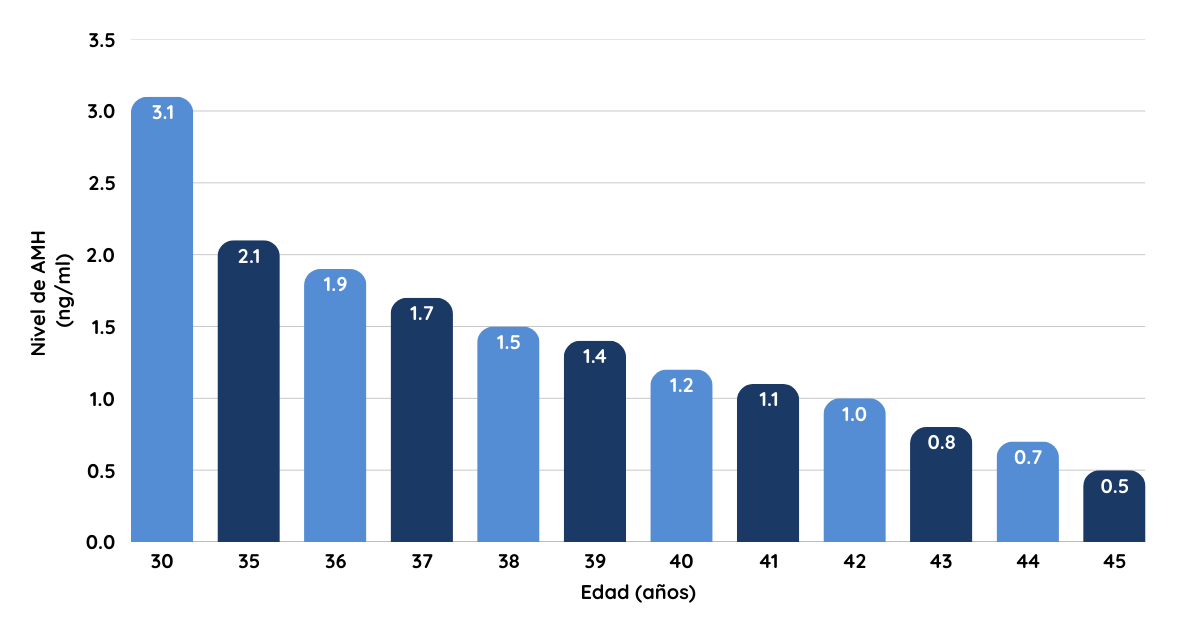
Cuanto mayor es la edad de la mujer más disminuye su reserva ovárica y, consecuentemente, sus niveles de AMH. La bajada más drástica tiene lugar a partir de los 35 años, pero algunas mujeres tienen una baja reserva incluso antes.
Knowing your levels allows us to assess your fertility status at that time and guide your treatment, knowing in advance how the ovary will respond, or whether it is necessary to consider egg donation. It will also allow us to decide on the hormonal medication regimen necessary in the event of performing IVF-ICSI treatment.
But it is not only interesting if you want to try to get pregnant right away; being aware of the AMH level is useful for those women who want to plan their motherhood. If the levels are good, they could choose to preserve their fertility to become a mother later with the eggs they freeze at that time. If, on the other hand, they have a low AMH value, they may even consider having children early.
What are normal values?
When we receive the results, and despite the fact that there is no standard for reference values, we usually make these interpretations (always taking into account the age of the patient):
- Entre 1,5 y 4 ng/ml: Niveles normales y adecuados a la edad.
- Por debajo de 1,5 ng/ml: Niveles «subóptimos», los resultados reproductivos pueden verse afectados.
- Por encima de 4 ng/ml: Podríamos estar frente a ovarios poliquísticos o correr el riesgo del síndrome de hiperestimulación ovárica al administrar la medicación hormonal.
At IGIN we request an AMH analysis together with the basal hormone between the first and third day of the menstrual cycle to assess both the ovarian reserve and other hormonal alterations. It is part of the fertility study that will allow us to make the best diagnosis for each case. estudio de fertilidad que nos permitirá realizar el mejor diagnóstico para cada caso.
Si estás interesada en conocer el estado de tu AMH o estás pensando en realizar un tratamiento, recuerda que puedes pedir tu consulta completamente gratuita con nosotros.