

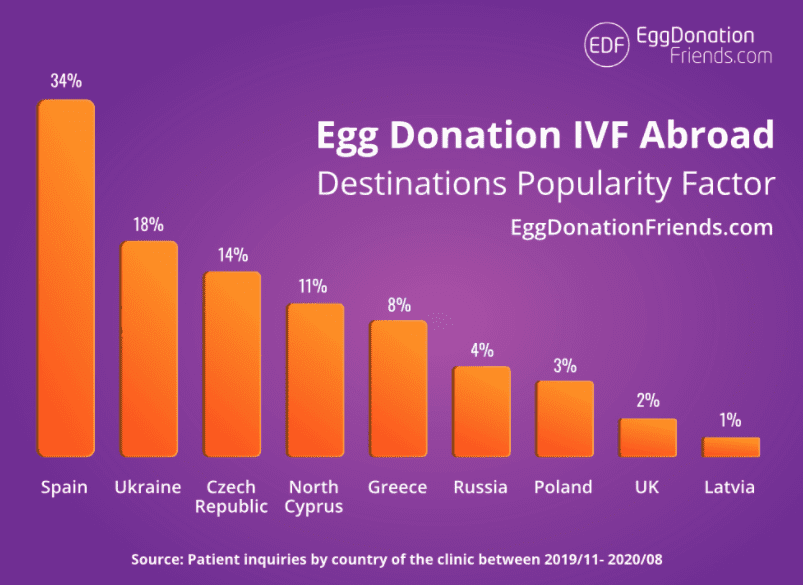
According to a study conducted by the web Egg Donation Friends, España es, con diferencia, el país de referencia para las pacientes internacionales que eligen realizar un tratamiento de ovodonación en el extranjero.
34% of them choose our country as their destination to fulfil their dream of becoming a mother. Following behind are Ukraine, with 18%, the Czech Republic, with 14%, and Cyprus, with 11%.
Patients who resort to oocyte donation to become mothers usually do so for several reasons:
- The restrictive legislation of their countries of origin to access egg donation programs.
- The age limit established in their countries to be able to become a mother through assisted reproduction.
- The policy that guarantees the anonymity of donors, which exists in countries such as Spain.
- The highest success rate in destination countries, due to the improvement of techniques.
- Better prepared clinics and professionals.
- Existence of treatments that are not common in the countries of origin, such as the ROPA method.
- Treatment costs are usually lower, although there is a wide range of prices and ranges in this regard.
The study also analyses the countries of preference based on the place of origin. Thus, we found that Spain is the most popular among patients from the United Kingdom, Ireland, Italy, France, the Netherlands or Belgium. In the Scandinavian countries (Sweden, Norway, Finland), Poland or Russia, it is more common to travel to Ukraine or the Czech Republic.
This upward trend in patients from abroad is also noticeable at iGin. For this reason, our customer service department has professionals dedicated exclusively to women from the United Kingdom, Italy or France, for example.
No dudes en contactar con nosotros para concertar una consulta online. Podremos ofrecerte un primer diagnóstico de fertilidad. Sin coste ni compromiso. Puedes hacerlo a través de este enlace o escribiéndonos a la dirección
These data were collected in 2019 and 2020, so the study highlights that they may have been conditioned by the arrival of the Covid pandemic.