
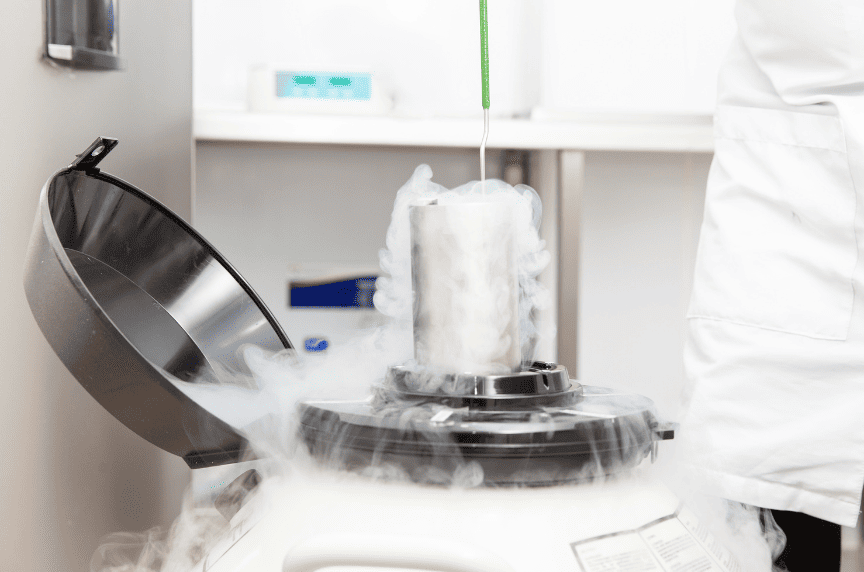
Freezing of the sperm sample
We preserve male fertility
What is it?
The process of preserving spermatozoa for future use. A sperm sample is collected and treated with cryoprotectants to prevent cell damage during cooling. The sample is frozen at very low temperatures (-196°C) using liquid nitrogen and is recorded and stored in our sperm bank. From there, it can be used whenever patients require it for any reproductive treatment, without compromising its quality over time.
When is it used?
Before starting reproductive treatments
To ensure that a quality semen sample is available at the appropriate time of the procedure.
Before medical treatments
Men who need to undergo oncological treatments (chemotherapy, radiotherapy) or surgeries that may affect their fertility.
Occupational or personal factors
Men with high-risk jobs that may affect their fertility or those who will be absent during treatment and for prolonged periods of time.
In case of vasectomy
Men who are undergoing a vasectomy but wish to keep the possibility of having children in the future.
Benefits of freezing a sperm sample
It provides flexibility during treatment by allowing the sample to be available at the right time.
It allows men to preserve their reproductive capability, even if they face medical treatments or conditions that may affect their fertility.
It provides security and peace of mind as a reliable solution for men who want to ensure they have viable sperm in case of health problems or accidents at work.
How is the sperm sample frozen?

The sample is obtained and collected in the clinic. In some cases it may be necessary to obtain it through a surgical procedure if ejaculation is not possible.

The sample is analysed to assess sperm concentration, motility, vitality and morphology. This allows the quality of the sperm to be determined and its suitability for freezing.

A cryoprotectant solution is added to protect the spermatozoa from damage during the process. The sample is then divided into several cryotubes, which are cooled with a controlled gradual freezing device. They are then transferred to storage tanks containing liquid nitrogen and kept at a constant temperature of -196°C.

Each cryotube is labelled with patient information and recorded in our tracking system to ensure that samples can be easily identified and retrieved when needed.
What results are to be expected?
Thanks to the use of modern freezing methods and cryoprotectants, the procedure of freezing and thawing of samples does not alter their chances of success. Also, the time the sample spends frozen does not reduce its quality.
Any questions?
We are here to answer any questions you may have about this or other techniques and treatments. We will get back to you as soon as possible.
Contact us

